EAGG meets Alison Lam, Social Practice Artist

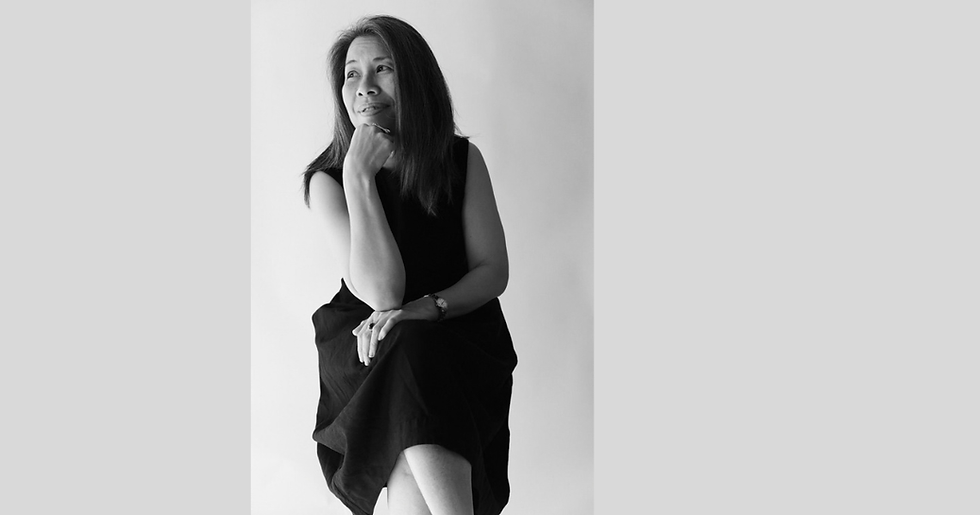
This month's spotlight falls upon Alison Lam, a social practice artist and practitioner. Alison is exploring how neurodivergent communication is often present but unrecognised within Cantonese and British-born Cantonese contexts. A mother of two sons with Autism and complex needs, she is a neurodivergent, interdisciplinary and socially-engaged artist working in mediums include porcelain, metals, glass and paper.
You are a ‘neurodivergent, interdisciplinary and socially-engaged artist’. Help us understand what this means.
I describe myself more often as a social practice and interdisciplinary artist. Being neurodivergent isn't just something I make work about — it affects how I see, process and experience the world, and therefore how I make.
I work across different materials and processes — porcelain, bronze, paper, thread, moving image, sound and participatory work. I often say that I am “drawing with my hands”, because sometimes making allows me to communicate something that I can't easily put into words.
The social practice part is really important. I am interested in what happens between people: the things we say, the things we don't say, and particularly the things that get misunderstood. Workshops and conversations are not separate from my artwork; they often become part of the work itself.
A lot of my practice sits in these unseen spaces — between speaking and silence, belonging and not belonging, being visible and being overlooked. I'm interested in how we communicate when language isn't enough.
Equally an artist and the mother of sons with Autism and complex needs, how have these potent elements shaped you and your work?
They are completely intertwined. I don't think I can separate being an artist, being neurodivergent myself and being a mother to neurodivergent children.
Being a mother changed the way I understood communication. I had to learn very early that communication isn't always verbal, and that behaviour is also a language. A gesture, a pause, withdrawing from a space, not looking at somebody, or needing to leave can communicate an enormous amount.
It also made me question what we call “normal” communication. Who decided what the correct way of communicating is? And what happens when somebody communicates differently and is continually misread?
There has also been grief, frustration, exhaustion and isolation, alongside love and resilience. I don't want to romanticise any of that. Some of those experiences have been incredibly difficult.
But they have made me notice things that perhaps I wouldn't otherwise notice. The tiny gestures. The pause before somebody enters a room. The person standing at the edge rather than in the centre.
Those things have become very important within my work. I think I'm continually asking: How do we create spaces where people don't have to perform being “normal” in order to belong?

You were born in Northern Ireland and have lived in Hong Kong, also lived, worked and raised your family in England for many years. What has been the significance of this ‘double-diasporic’ heritage in both your personal and professional life?
I think I've spent much of my life moving between different worlds without necessarily having the language for it.
I'm British and Chinese, but those identities aren't two neat halves. Growing up, there was one way of being at home and another way of being outside the home. There were different languages, expectations, behaviours and ways of expressing emotion.
I often think about the doorway as a metaphor for that. You cross the doorway and something shifts. You learn to read the room and adjust yourself accordingly.
Later, when I began understanding my own neurodivergence, I realised there was another layer to this. I wasn't only culturally switching; I had also spent a lot of my life masking.
So there are multiple layers of translation happening — British/Chinese, Cantonese/English, neurodivergent/neurotypical, mother/artist. Sometimes I belong to several places at once, and sometimes I don't quite belong anywhere.
That sense of being “in-between” has become incredibly important to my practice. Rather than trying to resolve it, I'm becoming more interested in that threshold itself — what can happen in that uncertain space between identities, languages and ways of understanding one another.

Your films, such as The Notion of the Beautifully Discarded, are vivid, emotional and brutally honest. Do you feel revealing these intimate layers of your life has been made more (or less) complex because of your East Asian heritage?
Yes, definitely.
There is a lot around shame that I am still trying to understand.
Within my own experience of Chinese culture, there were things you simply didn't talk about outside the family. Difficulties remained private. There was an awareness of how the family might be perceived by other people, and of not wanting to lose face or bring shame.
Then there are disability and neurodivergence, which add another layer. For a long time these weren't necessarily things that were openly discussed either.
So making personal work can feel quite exposing. There is always that question in the back of my mind: Am I allowed to say this? Am I revealing too much? Who else am I exposing by telling my own story?
But perhaps that discomfort is partly why I need to make the work.
I am interested in the Cantonese saying 鬼揞眼 — “a ghost covers one's eyes.” For me, it has become a way of thinking about the things that are there but somehow remain unseen — sometimes because society doesn't want to see them, sometimes because families don't talk about them, and sometimes because we have learnt not to see them ourselves.
I don't make intimate work because I want to reveal everything about my life. I'm actually quite interested in what remains hidden.
Maybe the work is about allowing just enough to become visible that somebody else can recognise something of themselves within it.
What are you working on right now and what would you want people who see it to take away from it?
At the moment I'm developing work that has grown from my recent residency in Penang and from a participatory project called Hidden Fibres / Messages Between.
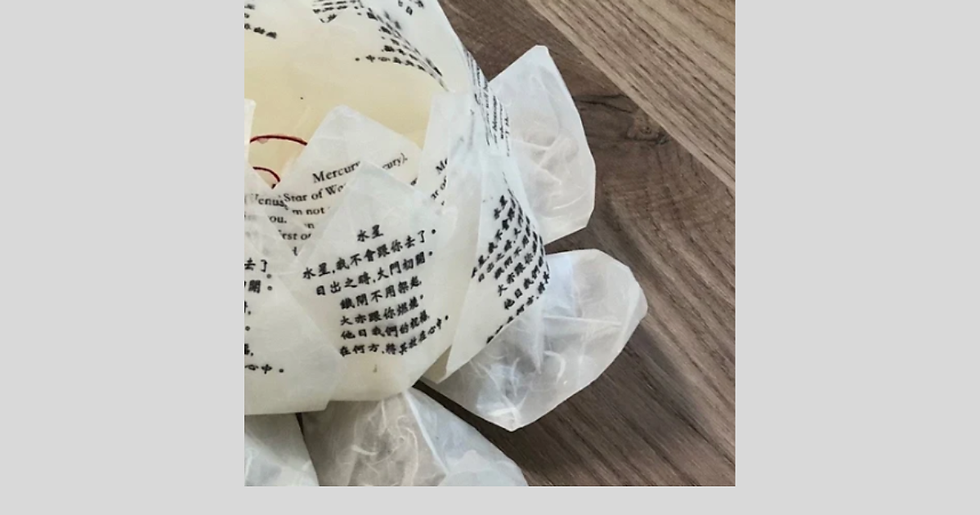
I invited people to write something they might not normally say aloud — about feeling different, unseen, misunderstood or about belonging — and then we enclosed these messages inside layers of Hanji paper.
What interested me was that the message was still physically there, but you couldn't necessarily read it.
That feels very connected to neurodivergence and also to my experience of diaspora. We carry so much underneath the surface: memories, sensory experiences, cultural expectations, things we haven't said, things we don't necessarily have words for.
The workshops eventually developed into an installation, A Field of Hidden Messages, where the individual pieces became part of a larger collective work.
I'm now interested in pushing that further through sound, moving image, projection and material processes such as porcelain and bronze, and particularly through conversations between people in different places and cultures.
I don't necessarily want somebody to walk away thinking they have “understood neurodivergence” or understood another person's experience.
I'd rather they leave with a question.
Perhaps: What might I not be seeing?
Or even: Who have I misunderstood?
East Asian Girl Gang is all about celebrating a shared cultural and ethnic heritage. What does it mean to you and why did you join?
For a long time I think I concentrated much more on the neurodivergent part of my identity than the East Asian part.
But increasingly I'm realising that I can't separate them.
There are experiences around family, silence, shame, expectation, achievement, belonging and communication that become different when looked at through an East Asian lens. And there is something incredibly valuable about being around other East Asian women where you don't necessarily have to explain every cultural reference or experience before you can begin the conversation.
That's part of why East Asian Girl Gang appealed to me.
I also really like the word “gang.” There is something playful but powerful about it. It suggests finding one another and saying: you belong here too.
For me, joining isn't about saying we all have the same East Asian experience — because obviously we don't. Our histories, cultures, languages, generations and experiences are incredibly different.
It's about having a space where those differences can exist alongside the things we recognise in one another.
At this stage in my life and practice, I'm becoming much more interested in understanding my own British Chinese identity rather than treating it as something that simply sits quietly in the background.
Perhaps I'm finally allowing that part of myself to take up a little more space.
To learn more about Alison's work, or to contact Alison:
website: www.alisonlam.art
instagram: @alisonlam_art


Comments